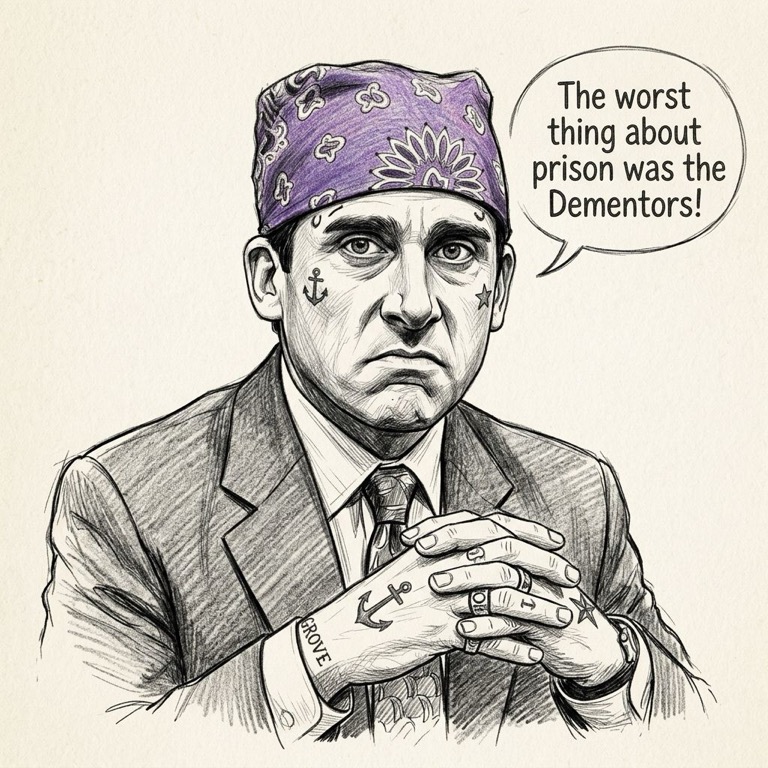
Ist mein Chef im Grunde Michael Scott?
Ein schnelles Quiz, um rote Flaggen bei Führung zu erkennen.
Wenn du „hasst mich mein Chef“ oder „ist mein Chef übergriffig“ gesucht hast, bist du richtig: das ist das kostenlose Quiz dazu, ob dein Chef toxisch ist.
10 Szenarien, schnelle Übergänge und Michael-Scott-Reaktionen nach jeder Antwort. Mit Tastatur: 1, 2 oder 3 für sofort antworten, ← → oder Enter um zwischen Fragen zu wechseln.
Bist du Führungskraft? Stattdessen zum Führungs-Quiz →
Fragen, die Leute stellen, bevor sie anfangen
Is my boss toxic?
A hard week is not the same thing as a toxic boss. The signal is a pattern that keeps showing up: criticism in front of other people, credit that moves upward, goals that change after you hit them, or a cost when you push back. This quiz is not a diagnosis. It is a way to name the last few months. Take the free quiz on this page.
Does my boss hate me?
It can feel personal when a manager is cold, short, or unfair. You cannot see motive from one tense meeting, and guessing at hate usually makes the week heavier. What you can check is behavior: feedback in private or blame in public, credit shared or credit taken, time off respected or treated as disloyalty. Take the free quiz on this page.
Is my boss abusive?
That is a serious question, and this quiz is not a legal finding. It can show whether humiliation, control, or retaliation is repeating. If you are being threatened, harmed, or punished for speaking up, contact HR if that is safe, or a legal aid or support resource where you live. This page does not give legal advice. When you want a plain read on the pattern, take the free quiz on this page.
How do I know if my boss is toxic?
Toxic bosses share a pattern of behaviors: public criticism, credit theft, shifting expectations, micromanagement, and retaliation for honest feedback. A single bad day is normal; a consistent pattern across months is the real signal. This quiz walks you through 10 common workplace scenarios to help you separate friction from a genuine red flag.
Is my boss just stressed or actually toxic?
Stressed managers still apologize, self-correct, and protect their team. Toxic managers externalize blame, withhold information, and escalate pressure downward. If you feel worse after most interactions with your manager — not the work — that's the tell.
Should I quit if my boss is toxic?
Quitting isn't always the right first move, but staying silent almost never helps. Start by documenting incidents, establishing a support network, and quietly exploring the job market. If your manager's behavior is affecting your health, relationships, or self-worth, leaving is a legitimate and often necessary choice.
Do I need to sign up to take this quiz?
No. The quiz is free and requires no account. At the end you'll see your result and can optionally subscribe to weekly job openings from companies that won't burn you out.
Methodik & Bewertung
Jedes Szenario entspricht einer dokumentierten roten Flagge aus peer-reviewed Forschung oder großen Arbeitsplatzumfragen. Die unten stehenden Quellen haben sowohl die Szenarien als auch die Bewertungsschwellen geformt.
Bewertung: Jedes Szenario wird mit 0 für gesund, 1 für gelegentliche Reibung oder 2 für ein anhaltendes Muster bewertet. Gesamtpunktzahlen reichen von 0 bis 20.
Quellen nach Szenario
- Der Feedback-Überfall — Zhao, Dunkailo, Clair & Boyd, "When Feedback Crosses the Line" (HBR, 2026). When Feedback Crosses the Line. 23% von 402 Angestellten berichteten von öffentlicher Bloßstellung, und 78% erinnerten sich Jahre später an destruktives Feedback.
- Das wandernde Ziel — Tubre & Collins, "Role Ambiguity, Role Conflict, and Job Performance" (Journal of Management, 2000). Role Ambiguity, Role Conflict, and Job Performance. Metaanalyse zeigt, dass Rollenunklarheit stark Stress, Burnout und niedrigere Leistung vorhersagt.
- Der Credit-Dieb — Chen, Li, Yang, Zhang & Hou, "The Idea Is Mine!" (Frontiers in Psychology, 2022). The Idea Is Mine!. In 418 Führungskraft-Angestellten-Paaren löste Anerkennung stehlen Ärger aus und reduzierte Arbeitsleistung.
- Der Loyalitätstest — Parker & Dinesh, "More than 4 in 10 U.S. workers don’t take all their paid time off" (Pew Research, 2023). More than 4 in 10 U.S. workers don’t take all their paid time off. 46% nutzen Urlaub zu wenig, und 21% fürchten Jobverlust fürs Urlaubnehmen.
- Der innere Kreis — Graen & Uhl-Bien, "Development of Leader-Member Exchange (LMX) Theory" (The Leadership Quarterly, 1995); Li, "Perceived Workplace Favoritism" (Central Michigan University, 2018). Perceived Workplace Favoritism. 47% der Angestellten berichteten von Vetternwirtschaft, und selbst bevorzugte Angestellte zeigten höhere Erschöpfung und Kündigungsabsicht.
- Die Feuerübung — Smith, "5 Tactics to Combat a Culture of False Urgency at Work" (HBR, 2023). 5 Tactics to Combat a Culture of False Urgency at Work. Falsche Dringlichkeit tötet Deep Work und treibt zum Burnout; Multitasking aus Dringlichkeitskultur kann Produktivität dramatisch senken.
- Die Informationsfalle — Jiang, "Why Withholding Information at Work Won’t Give You an Advantage" (HBR, 2019). Why Withholding Information at Work Won’t Give You an Advantage. Wissenshüter gedeihen weniger, und schlechtes Informationsteilen ist teuer im großen Maßstab.
- Die ethische Grauzone — Kish-Gephart, Harrison & Trevino, "Bad Apples, Bad Cases, and Bad Barrels" (Journal of Applied Psychology, 2010). Bad Apples, Bad Cases, and Bad Barrels. Organisatorischer Druck treibt unethische Entscheidungen mehr als individueller Charakter in der Metaanalyse.
- Der Mikromanager — Zak, "The Neuroscience of Trust" (HBR, 2017). The Neuroscience of Trust. Unternehmen mit hohem Vertrauen sehen weniger Stress, mehr Energie und höhere Produktivität. Autonomie ist das Gegenmittel zu Mikromanagement.
- Der langsame Abfluss — Salvagioni et al., "Physical, psychological and occupational consequences of job burnout" (PLoS ONE, 2017). Physical, psychological and occupational consequences of job burnout. Burnout sagt Herz-Kreislauf-Erkrankungen, Depression, Schlaflosigkeit und erhöhtes Sterberisiko voraus.
Basisumfragen
- Gallup, State of the Global Workplace (2024) — Manager machen 70% der Varianz im Mitarbeiterengagement aus, und die Hälfte aller Angestellten hat einen Job wegen eines Managers gekündigt.
- SHRM Workplace Survey (2020) — 84% der US-Arbeitskräfte sagen, dass schlecht ausgebildete Manager unnötigen Stress erzeugen.