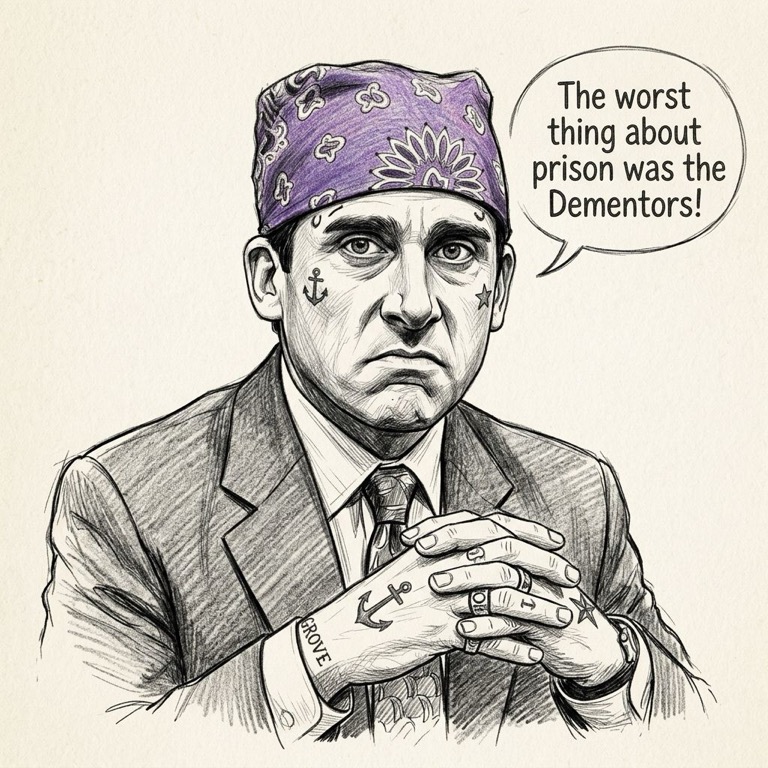
Est-ce que mon boss est littéralement Michael Scott ?
Un quiz rapide pour détecter les red flags de management.
Si vous avez cherché « est-ce que mon boss me déteste » ou « est-ce que mon boss est abusif », vous êtes au bon endroit : c'est le quiz gratuit pour savoir si votre boss est toxique.
10 scénarios de travail, enchaînements rapides, et réactions de Michael Scott après chaque réponse. Avec un clavier, appuyez sur 1, 2 ou 3 pour répondre immédiatement, et ← → ou Entrée pour passer d'une question à l'autre.
Tu es manager ? Passer le quiz manager →
Questions que les gens se posent avant de commencer
Is my boss toxic?
A hard week is not the same thing as a toxic boss. The signal is a pattern that keeps showing up: criticism in front of other people, credit that moves upward, goals that change after you hit them, or a cost when you push back. This quiz is not a diagnosis. It is a way to name the last few months. Take the free quiz on this page.
Does my boss hate me?
It can feel personal when a manager is cold, short, or unfair. You cannot see motive from one tense meeting, and guessing at hate usually makes the week heavier. What you can check is behavior: feedback in private or blame in public, credit shared or credit taken, time off respected or treated as disloyalty. Take the free quiz on this page.
Is my boss abusive?
That is a serious question, and this quiz is not a legal finding. It can show whether humiliation, control, or retaliation is repeating. If you are being threatened, harmed, or punished for speaking up, contact HR if that is safe, or a legal aid or support resource where you live. This page does not give legal advice. When you want a plain read on the pattern, take the free quiz on this page.
How do I know if my boss is toxic?
Toxic bosses share a pattern of behaviors: public criticism, credit theft, shifting expectations, micromanagement, and retaliation for honest feedback. A single bad day is normal; a consistent pattern across months is the real signal. This quiz walks you through 10 common workplace scenarios to help you separate friction from a genuine red flag.
Is my boss just stressed or actually toxic?
Stressed managers still apologize, self-correct, and protect their team. Toxic managers externalize blame, withhold information, and escalate pressure downward. If you feel worse after most interactions with your manager — not the work — that's the tell.
Should I quit if my boss is toxic?
Quitting isn't always the right first move, but staying silent almost never helps. Start by documenting incidents, establishing a support network, and quietly exploring the job market. If your manager's behavior is affecting your health, relationships, or self-worth, leaving is a legitimate and often necessary choice.
Do I need to sign up to take this quiz?
No. The quiz is free and requires no account. At the end you'll see your result and can optionally subscribe to weekly job openings from companies that won't burn you out.
Méthodologie et notation
Chaque scénario correspond à une red flag documentée dans la recherche peer-reviewed ou de grandes enquêtes sur le travail. Les sources ci-dessous ont formé à la fois les scénarios et les seuils de notation.
Notation : Chaque scénario est noté 0 pour sain, 1 pour friction occasionnelle, ou 2 pour un pattern persistant. Les scores totaux vont de 0 à 20.
Sources par scénario
- L'embuscade feedback — Zhao, Dunkailo, Clair & Boyd, "When Feedback Crosses the Line" (HBR, 2026). When Feedback Crosses the Line. 23% de 402 employés ont rapporté une humiliation publique, et 78% se rappelaient du feedback destructeur des années plus tard.
- La cible mouvante — Tubre & Collins, "Role Ambiguity, Role Conflict, and Job Performance" (Journal of Management, 2000). Role Ambiguity, Role Conflict, and Job Performance. Une méta-analyse montre que l'ambiguïté de rôle prédit fortement stress, burn-out et performance réduite.
- Le voleur de crédit — Chen, Li, Yang, Zhang & Hou, "The Idea Is Mine!" (Frontiers in Psychology, 2022). The Idea Is Mine!. Dans 418 paires leader-employé, revendiquer le crédit a déclenché colère et réduit la performance au travail.
- Le test de loyauté — Parker & Dinesh, "More than 4 in 10 U.S. workers don’t take all their paid time off" (Pew Research, 2023). More than 4 in 10 U.S. workers don’t take all their paid time off. 46% sous-utilisent les vacances, et 21% craignent la perte d'emploi pour les prendre.
- Le cercle intérieur — Graen & Uhl-Bien, "Development of Leader-Member Exchange (LMX) Theory" (The Leadership Quarterly, 1995); Li, "Perceived Workplace Favoritism" (Central Michigan University, 2018). Perceived Workplace Favoritism. 47% des employés ont rapporté du favoritisme, et même les employés favorisés ont montré plus d'épuisement et d'intention de démission.
- L'exercice incendie — Smith, "5 Tactics to Combat a Culture of False Urgency at Work" (HBR, 2023). 5 Tactics to Combat a Culture of False Urgency at Work. La fausse urgence tue le travail profond et pousse au burn-out ; le multitâche de culture d'urgence peut réduire drastiquement la productivité.
- Le piège à info — Jiang, "Why Withholding Information at Work Won’t Give You an Advantage" (HBR, 2019). Why Withholding Information at Work Won’t Give You an Advantage. Les cacheurs de connaissance prospèrent moins, et mal partager l'info coûte cher à grande échelle.
- La zone grise éthique — Kish-Gephart, Harrison & Trevino, "Bad Apples, Bad Cases, and Bad Barrels" (Journal of Applied Psychology, 2010). Bad Apples, Bad Cases, and Bad Barrels. La pression organisationnelle pousse aux décisions non éthiques plus que le caractère individuel dans la méta-analyse.
- Le micromanager — Zak, "The Neuroscience of Trust" (HBR, 2017). The Neuroscience of Trust. Les entreprises à haute confiance voient moins de stress, plus d'énergie et plus de productivité. L'autonomie est l'antidote au micromanagement.
- Le drain lent — Salvagioni et al., "Physical, psychological and occupational consequences of job burnout" (PLoS ONE, 2017). Physical, psychological and occupational consequences of job burnout. Le burn-out prédit les maladies cardiovasculaires, dépression, insomnie et risque de mortalité élevé.
Enquêtes de référence
- Gallup, State of the Global Workplace (2024) — Les managers représentent 70% de la variance dans l'engagement employé, et la moitié de tous les employés ont quitté un job à cause d'un manager.
- SHRM Workplace Survey (2020) — 84% des travailleurs US disent que les managers mal formés créent du stress inutile.