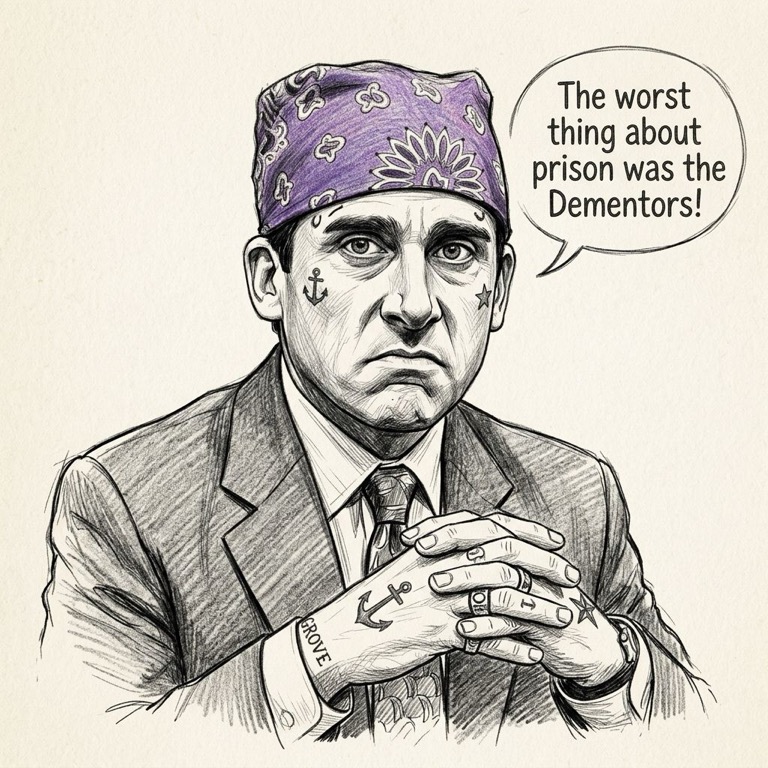
Is My Boss Basically Michael Scott?
A quick quiz to spot management red flags.
If you searched "does my boss hate me" or "is my boss abusive," you are in the right place: this is the free is-my-boss-toxic quiz.
You'll get 10 workplace scenarios, fast transitions, and Michael Scott reactions after each answer. With a keyboard, press 1, 2, or 3 to answer instantly, and ← → or Enter to move between questions.
Are you a manager? Take the manager quiz instead →
Questions people ask before they start
Is my boss toxic?
A hard week is not the same thing as a toxic boss. The signal is a pattern that keeps showing up: criticism in front of other people, credit that moves upward, goals that change after you hit them, or a cost when you push back. This quiz is not a diagnosis. It is a way to name the last few months. Take the free quiz on this page.
Does my boss hate me?
It can feel personal when a manager is cold, short, or unfair. You cannot see motive from one tense meeting, and guessing at hate usually makes the week heavier. What you can check is behavior: feedback in private or blame in public, credit shared or credit taken, time off respected or treated as disloyalty. Take the free quiz on this page.
Is my boss abusive?
That is a serious question, and this quiz is not a legal finding. It can show whether humiliation, control, or retaliation is repeating. If you are being threatened, harmed, or punished for speaking up, contact HR if that is safe, or a legal aid or support resource where you live. This page does not give legal advice. When you want a plain read on the pattern, take the free quiz on this page.
How do I know if my boss is toxic?
Toxic bosses share a pattern of behaviors: public criticism, credit theft, shifting expectations, micromanagement, and retaliation for honest feedback. A single bad day is normal; a consistent pattern across months is the real signal. This quiz walks you through 10 common workplace scenarios to help you separate friction from a genuine red flag.
Is my boss just stressed or actually toxic?
Stressed managers still apologize, self-correct, and protect their team. Toxic managers externalize blame, withhold information, and escalate pressure downward. If you feel worse after most interactions with your manager — not the work — that's the tell.
Should I quit if my boss is toxic?
Quitting isn't always the right first move, but staying silent almost never helps. Start by documenting incidents, establishing a support network, and quietly exploring the job market. If your manager's behavior is affecting your health, relationships, or self-worth, leaving is a legitimate and often necessary choice.
Do I need to sign up to take this quiz?
No. The quiz is free and requires no account. At the end you'll see your result and can optionally subscribe to weekly job openings from companies that won't burn you out.
Methodology & Scoring
Each scenario maps to a workplace red flag documented in peer-reviewed research or major workplace surveys. The sources below shaped both the scenarios and the scoring thresholds.
Scoring: Each scenario is scored 0 for healthy, 1 for occasional friction, or 2 for a persistent pattern. Total scores range from 0 to 20.
Sources by scenario
- The Feedback Ambush — Zhao, Dunkailo, Clair & Boyd, "When Feedback Crosses the Line" (HBR, 2026). When Feedback Crosses the Line. 23% of 402 employees reported public shaming, and 78% remembered destructive feedback years later.
- The Moving Target — Tubre & Collins, "Role Ambiguity, Role Conflict, and Job Performance" (Journal of Management, 2000). Role Ambiguity, Role Conflict, and Job Performance. Meta-analysis showing that role ambiguity strongly predicts stress, burnout, and lower performance.
- The Credit Thief — Chen, Li, Yang, Zhang & Hou, "The Idea Is Mine!" (Frontiers in Psychology, 2022). The Idea Is Mine!. In 418 leader-employee pairs, credit claiming triggered anger and reduced job performance.
- The Loyalty Test — Parker & Dinesh, "More than 4 in 10 U.S. workers don’t take all their paid time off" (Pew Research, 2023). More than 4 in 10 U.S. workers don’t take all their paid time off. 46% underuse PTO, and 21% fear job loss for taking it.
- The Inner Circle — Graen & Uhl-Bien, "Development of Leader-Member Exchange (LMX) Theory" (The Leadership Quarterly, 1995); Li, "Perceived Workplace Favoritism" (Central Michigan University, 2018). Perceived Workplace Favoritism. 47% of employees reported favoritism, and even favored employees showed higher exhaustion and turnover intent.
- The Fire Drill — Smith, "5 Tactics to Combat a Culture of False Urgency at Work" (HBR, 2023). 5 Tactics to Combat a Culture of False Urgency at Work. False urgency kills deep work and pushes burnout; multitasking from urgency culture can cut productivity dramatically.
- The Information Trap — Jiang, "Why Withholding Information at Work Won’t Give You an Advantage" (HBR, 2019). Why Withholding Information at Work Won’t Give You an Advantage. Knowledge hiders are less likely to thrive, and poor information sharing is expensive at scale.
- The Ethical Gray Zone — Kish-Gephart, Harrison & Trevino, "Bad Apples, Bad Cases, and Bad Barrels" (Journal of Applied Psychology, 2010). Bad Apples, Bad Cases, and Bad Barrels. Organizational pressure drives unethical decisions more than individual character in the meta-analysis.
- The Micromanager — Zak, "The Neuroscience of Trust" (HBR, 2017). The Neuroscience of Trust. High-trust companies see less stress, more energy, and higher productivity. Autonomy is the antidote to micromanagement.
- The Slow Drain — Salvagioni et al., "Physical, psychological and occupational consequences of job burnout" (PLoS ONE, 2017). Physical, psychological and occupational consequences of job burnout. Burnout predicts cardiovascular disease, depression, insomnia, and elevated mortality risk.
Baseline surveys
- Gallup, State of the Global Workplace (2024) — Managers account for 70% of the variance in employee engagement, and half of all employees have quit a job because of a manager.
- SHRM Workplace Survey (2020) — 84% of U.S. workers say poorly trained managers create unnecessary stress.