Signs of a Bad Company Culture: 12 Red Flags Before You Accept the Job Offer
Spot bad company culture before day one with 12 concrete red flags, from vague values to chaotic remote policies and burnout disguised as ambition.

The signs of a bad company culture usually show up before your first day. They appear in vague interview answers, rushed hiring loops, and leaders who talk about values without explaining how work actually gets done. If you are trying to decide whether to accept an offer, use this guide to spot the warning signs early, pressure-test what you hear, and compare the opportunity against healthier employers in the Calm Companies directory.
A bad workplace culture does not always look dramatic. Sometimes it looks polished on the surface and unstable underneath: high expectations with no prioritization, flexibility promised but inconsistently applied, or feedback framed as "you should just be more resilient." If any of that feels familiar, compare the pattern against our guides to signs of a toxic workplace, company culture interview questions, and remote work policy red flags before you say yes.
If you are actively job searching, the Calm Companies newsletter sends curated openings from employers that respect boundaries and sustainable pace. It is free, and it saves you from scrolling through noisy job boards while you screen for these red flags.
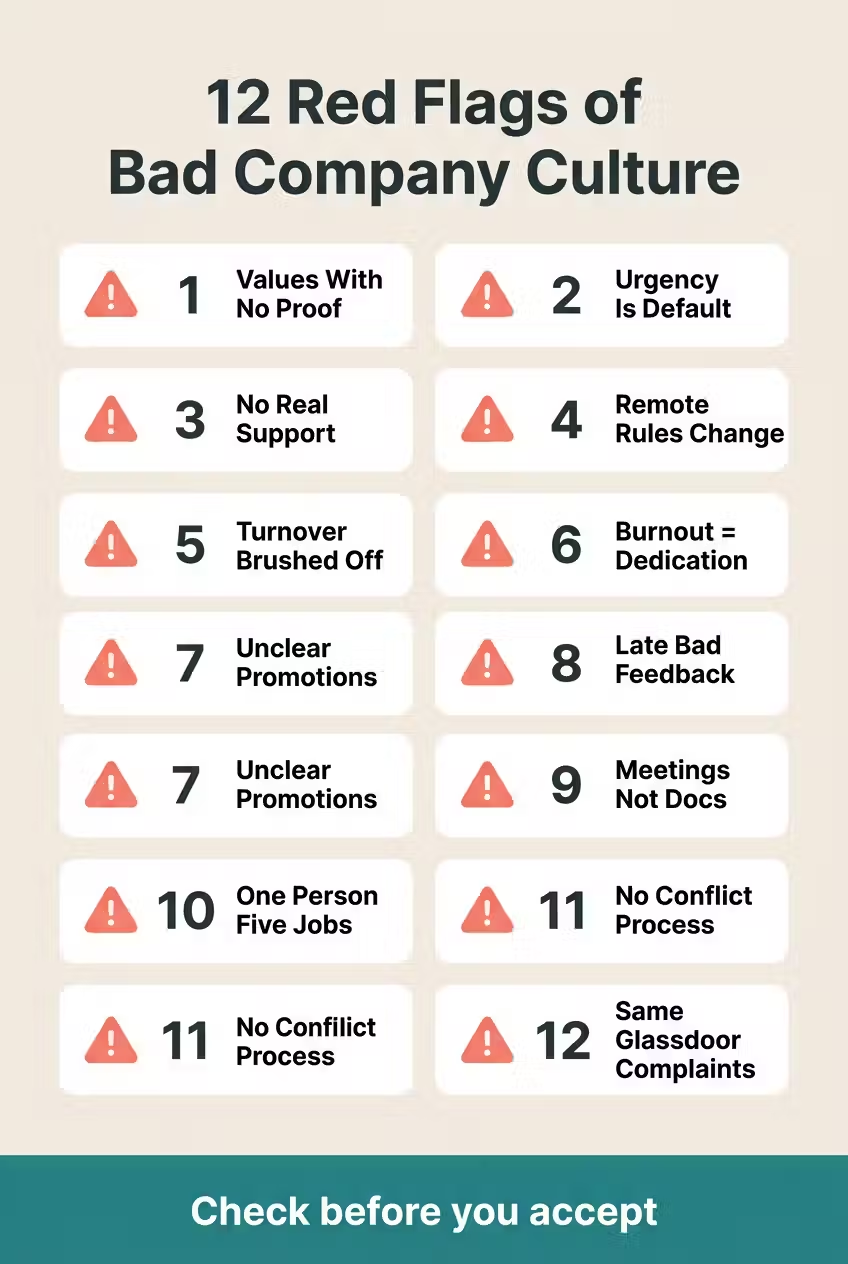
What are the signs of a bad company culture?
The clearest signs of a bad company culture are inconsistency, ambiguity, and misaligned incentives. Healthy teams can explain how decisions get made, how feedback works, and what sustainable performance looks like. Toxic company culture usually reveals itself when interviewers dodge specifics, normalize chaos, or expect trust without transparency. The goal is not to find a perfect employer. It is to avoid a company where the operating system makes good work unnecessarily hard.
12 bad company culture red flags to watch before you accept
1. The values sound impressive, but nobody can explain the tradeoffs
Most bad company culture red flags start with a gap between branding and behavior. You will hear words like ownership, transparency, excellence, or bias for action, but no one can tell you how those values shape hiring, planning, performance reviews, or conflict resolution. Ask for a recent example of a hard decision where two values pulled in opposite directions. Strong companies can describe the tradeoff. Weak ones repeat the slogan.
2. Urgency is described as the normal way of working
A company with healthy pace treats urgency as exceptional. A company with bad workplace culture treats urgency as identity. Listen for phrases like "we move fast," "things change constantly," or "everyone wears a lot of hats" when they are used to excuse poor planning. If an interviewer cannot tell you how priorities are reset when work expands, you are looking at a workload problem that will eventually land on you.
3. Managers talk about ownership, but not support, systems, or staffing
One of the most reliable signs of a bad company culture is when leaders want senior-level accountability from every employee while offering junior-level support. Ownership is healthy when roles are clear, documentation exists, and managers remove blockers. It becomes a red flag when it really means "figure it out alone, absorb the stress, and do not surface problems unless you have already fixed them." That is not empowerment. It is organizational offloading.
4. Remote or hybrid expectations change depending on who you ask
Bad company culture often shows up in remote policy drift. Recruiters say the role is flexible. The hiring manager says the team usually meets in person. A future peer tells you leadership wants more office time next quarter. That inconsistency matters because unclear flexibility policies usually signal informal power structures. Revisit our breakdown of remote work policy red flags if the details keep changing during the interview process.
5. People mention turnover, then immediately minimize it
Turnover alone is not proof of toxic company culture. The signal is how the company explains it. Healthy teams can tell you what changed after several departures. Unhealthy teams shrug and say it was just not the right fit, the market was weird, or the people who left were not resilient enough. When a pattern is real, mature leadership shows what they learned from it. Defensive spin usually means the lesson was ignored.
6. Burnout is framed as evidence that people care
Be careful when a company romanticizes intensity. If employees are praised mainly for staying late, stepping in during weekends, or being endlessly available, the culture is rewarding visible sacrifice instead of sustainable output. That is how bad company culture turns into a toxic work environment over time. The people who survive longest are not necessarily the best performers. They are often the people most willing to absorb unmanaged stress.
7. Promotions and performance standards are vague
Good cultures make advancement legible. You know what is expected, what counts as impact, and how your work will be evaluated. Bad cultures keep that logic fuzzy. If you ask how people get promoted and hear some version of "it depends" without a documented rubric, assume success is tied to manager preference, political timing, or visibility theater. That creates anxiety, internal competition, and a lot of wasted effort.
8. Feedback is inconsistent, political, or delayed until it becomes punitive
Another sign of a bad company culture is that nobody knows where they stand until a problem becomes serious. In healthy teams, feedback is specific, frequent, and tied to observable behavior. In unhealthy ones, feedback arrives late, gets softened until it is useless, or shows up only when a manager needs to justify a decision already made. Ask how one-on-ones work, what written feedback looks like, and how managers course-correct performance early.
Validate employers before final rounds
Check stability and workload indicators before you accept the offer.
9. Meetings replace documentation and decision-making
A company culture red flag many candidates miss is when every important conversation has to happen live because decisions are not documented anywhere. That forces people into more meetings, rewards the loudest voices, and makes remote collaboration harder than it should be. You can usually detect this by asking how decisions get captured after planning sessions or incident reviews. If the answer is vague, accountability is probably vague too.
10. The role sounds permanently broader than the team can support
Sometimes bad company culture hides inside role design. The company says they want one person to own strategy, execution, hiring, operations, analytics, and stakeholder communication, but the compensation, tooling, and team structure do not match that scope. That mismatch usually means the business is under-resourced or has normalized heroic effort. A hard role can still be a good role. An impossible role is a culture warning.
11. No one can explain how conflict gets resolved
Healthy company culture is not the absence of conflict. It is the presence of a workable process for handling it. Ask what happens when product and engineering disagree on priority, or when a manager and direct report see a situation differently. Good answers include a repeatable process, clear decision ownership, and a way to revisit bad calls. Bad answers default to personality, seniority, or whatever leadership wants in the moment.
12. Former employee reviews repeat the same pattern
No review site is perfect, but repeated complaints about the same issue are useful signal. If multiple employees across different years mention micromanagement, chaotic direction, unpaid overtime, or leadership opacity, treat that as evidence to investigate. One angry review can be noise. A repeating pattern is data. Use reviews to build sharper follow-up questions, not to make the whole decision for you.
How to spot bad company culture in an interview
Start with questions that force specificity. Ask what changed on the team in the last six months, how priorities are reset when work expands, what caused the last missed deadline, and how disagreement gets handled. Our guide to company culture interview questions gives you more prompts, but the principle is simple: vague questions get polished answers, and precise questions expose how the company actually operates. You are not just screening for nice people. You are screening for systems that make calm, sustainable performance possible.
What to do if you notice these red flags before accepting
Slow the process down. Summarize the concerns in writing, ask direct follow-up questions, and compare the answers across recruiter, hiring manager, and future peers. If the story keeps changing, assume the experience will be more confusing once you are inside. It is far easier to walk away before you sign than to recover after you join the wrong team.
If you need alternatives quickly, spend time in the Calm Companies directory and use the newsletter CTA on this page so new openings come to you instead of forcing you back into noisy job boards. Better options are easier to choose when you are not negotiating from scarcity.
FAQ: signs of a bad company culture
Can a company pay well and still have a bad culture?
Yes. Compensation can hide bad culture for a while, especially in companies that solve every execution problem with more cash or equity. High pay does not remove the cost of unclear expectations, reactive leadership, or constant stress. The real question is whether the role is sustainable enough for you to do strong work without trading away your health or leverage.
Are review sites enough to judge company culture?
No. Reviews are one input, not a verdict. Use them to spot repeated themes, then verify those themes in interviews and through your network. The most useful question is not "Is every review true?" It is "What would have to be true inside this company for so many people to describe the same problem?"
What is the difference between a bad company culture and a hard quarter?
A hard quarter has a specific cause, a bounded timeline, and a plan to return to normal. Bad company culture turns the exception into the baseline. If the company cannot describe what healthy looks like, or if every hard season seems to roll directly into the next one, the problem is probably structural rather than temporary.
Final takeaway
The signs of a bad company culture are easiest to see when you stop asking whether the team seems nice and start asking whether the system seems stable. Look for clear expectations, consistent answers, and evidence that leadership protects focus instead of consuming it. If those signals are missing, keep looking. One calm offer is better than one fast offer you will need to escape six months from now.
Get calm-company opportunities every week
Use the directory and subscribe so you can move fast when better roles open.