Complete Burnout Recovery Guide
Burnout does not end with one long weekend. This burnout recovery guide shows how to reduce the drain, rebuild energy, and decide whether your current job can become sustainable.
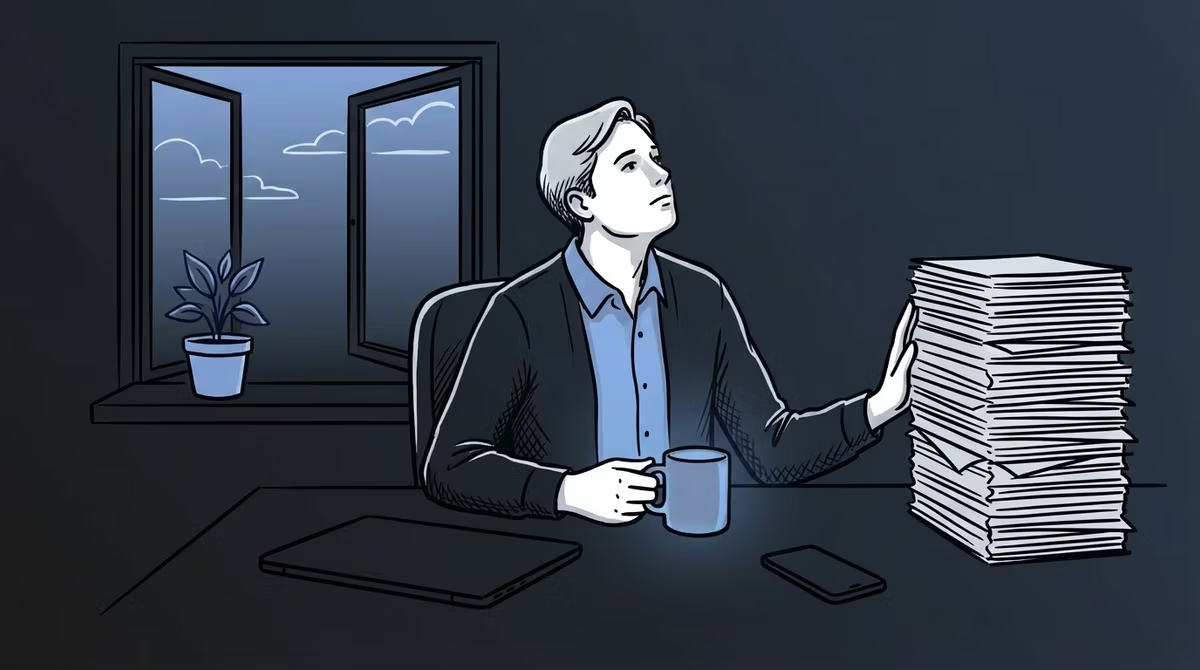
If work feels heavy before the morning starts, your patience is gone, and rest never sticks, you do not need better productivity hacks. You need a plan that lowers the pressure causing the damage and helps your body and mind regain capacity.
If you want a calmer next step, join the Calm Companies newsletter for the free recovery guide PDF, then explore the Calm Companies job board when you are ready to look at healthier roles. You do not need to solve everything today, but you do need options.
What a burnout recovery guide should actually help you do
Burnout recovery is not about becoming more efficient inside the same unhealthy setup. It is about reducing chronic stress, restoring basic energy, and getting clear enough to decide what needs to change.
- Stop the active depletion so your days are no longer draining you faster than you can recover.
- Rebuild basic capacity: sleep, focus, emotional regulation, and the ability to make simple decisions.
- Figure out whether your current role can become sustainable, or whether recovery requires a bigger job change.
How to tell whether you need burnout recovery now
Many people wait until they are fully depleted before naming burnout. The pattern usually starts earlier, with rising irritability, numbness, and the kind of exhaustion described in common overworked symptoms.
If the deeper issue is being overworked and underpaid, burnout often shows up as resentment, shame, and the feeling that no amount of effort changes anything. That effort-to-reward mismatch matters because it teaches your nervous system that work is all cost and no relief.
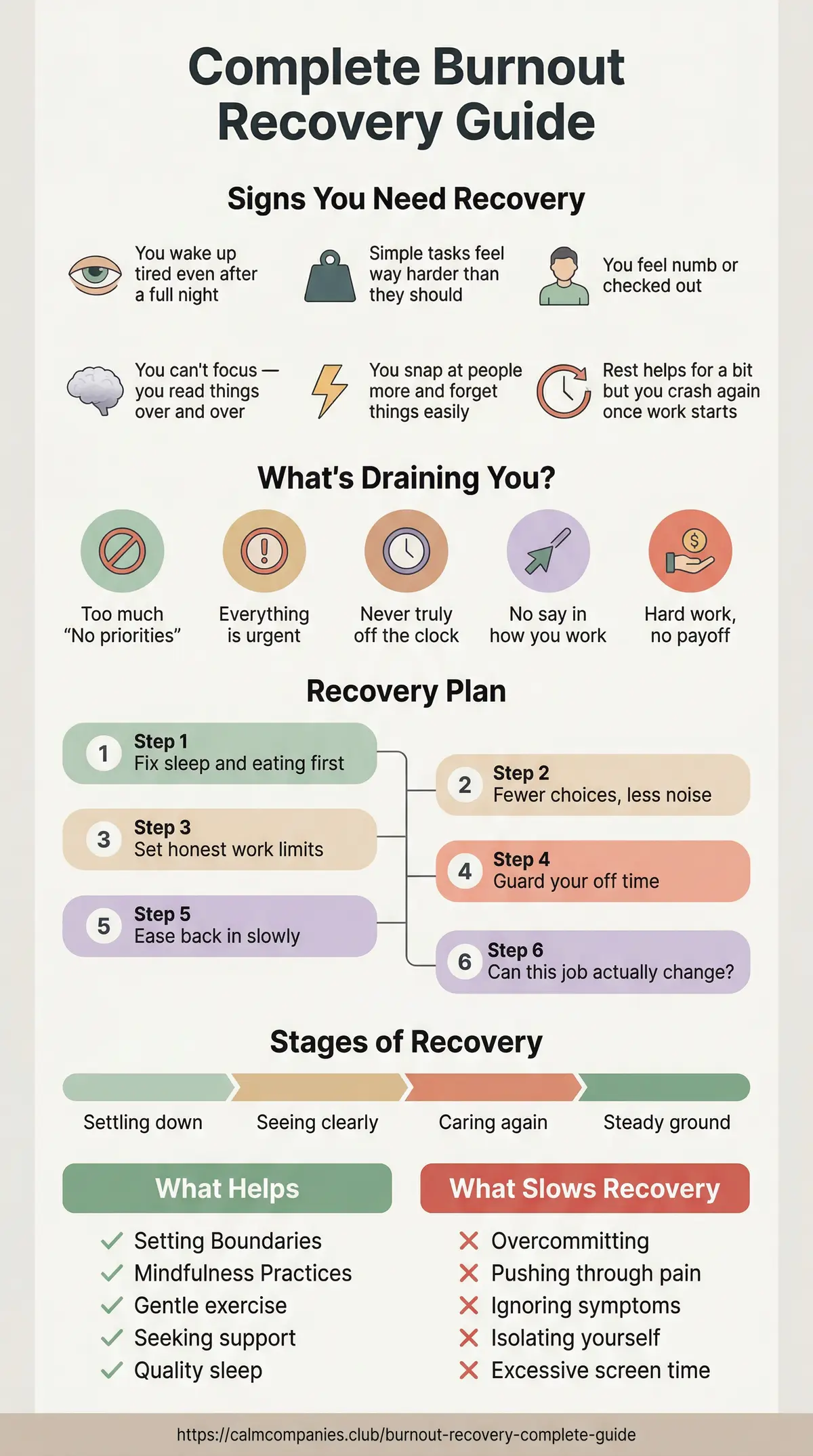
- You wake up tired, even after a full night in bed.
- Small requests feel unreasonably hard, and routine tasks take far more energy than they used to.
- You feel detached, cynical, or emotionally flat at work.
- Your concentration is worse. You reread the same message or document without absorbing it.
- You are more reactive, more forgetful, or much less patient with coworkers and people you care about.
- Time off helps briefly, but the crash returns as soon as work pressure comes back.
The first rule of burnout recovery: remove the drain
A good weekend, a meditation app, or a better morning routine cannot out-recover a job that keeps taking more than it gives. The first question is simple: what is draining you faster than you can recover?
- Unclear workload: too many priorities, too little time, and no real way to finish well.
- Urgency culture: everything is treated as critical, so your body never gets a signal that it is safe to stand down.
- Always-on communication: pings, late messages, and the expectation that availability equals commitment.
- Low control: you are responsible for outcomes but have very little influence over timing, scope, or resources.
- Effort without reward: your work is intense, but recognition, pay, growth, or recovery time never catches up.
Pick the one or two drains you can reduce first. Recovery gains traction when the daily injury gets smaller, not when your coping strategy gets more elaborate.
A step-by-step burnout recovery plan
If you want practical scripts for the workplace part of this process, start with how to recover from burnout at work. Then use the sequence below to lower stress without expecting yourself to become a different person overnight.
Step 1: Stabilize sleep, food, and physical recovery
Burnout makes basic self-care feel strangely difficult, which is exactly why you start there. You do not need an optimized wellness plan. You need enough sleep, enough food, enough water, and enough quiet for your system to stop running in emergency mode.
- Keep your wake time and bedtime as consistent as your schedule allows.
- Eat regular meals, even if they are simple and repetitive for a while.
- Get outside or move your body lightly each day, even if it is only a short walk.
- If you have chest pain, severe insomnia, panic, or worsening depression, talk to a clinician instead of trying to push through.
Step 2: Cut inputs and decisions
An overloaded brain treats every small choice like work. Reduce avoidable inputs for a few weeks so your mental energy is not spent on low-value decisions before the real day even starts.
- Mute nonessential notifications and stop checking messages in every gap.
- Repeat meals, clothes, and routines that make the day easier.
- Delay optional commitments until you feel steadier.
- Let boredom, quiet, and empty space back into your schedule.
Step 3: Reset work expectations in writing
Burnout recovery usually stalls when the job keeps operating as if nothing is wrong. Make the workload visible, clarify tradeoffs, and put boundaries in writing so expectations do not quietly expand again.
- Name your actual capacity, not the heroic version of it.
- Ask which priorities should move if something urgent gets added.
- Use out-of-office time fully instead of staying half available.
- Set a clear end to your day and stop rewarding late requests with immediate replies.
Step 4: Protect one real recovery window every day
A recovery window is not time for errands, catch-up work, or personal admin. It is time where your brain is not performing, managing, or producing. Burnout improves when your system gets repeated proof that it can be off duty.
Step 5: Rebuild capacity slowly
Once you feel a little better, resist the urge to snap back to your old high-output self. Recovery lasts longer when you add demand gradually. The goal is not a brief bounce-back. The goal is a life and workload you can sustain.
Step 6: Decide whether the job can be repaired
Validate employers before final rounds
Check stability and workload indicators before you accept the offer.
Sometimes burnout is mostly about pace, boundaries, and a season of overload. Sometimes the environment itself is the injury. If you have reduced the drain, asked for changes, taken time off, and still feel your system brace every morning, the role may not be recoverable for you.
Stages of burnout recovery
Burnout recovery often moves in stages, even if they overlap. Knowing that helps because many people expect to feel dramatically better all at once, then assume they are failing when progress comes in smaller, uneven shifts.
- Stabilization: sleep, appetite, and emotional intensity begin to even out, but you still feel fragile.
- Clarity: your thoughts feel less foggy, and you can finally identify what is actually stressing you.
- Reengagement: motivation returns in short bursts, and ordinary tasks feel less heavy.
- Sustainability: you can work, rest, and recover without swinging between overdrive and collapse.
You can move forward and backward between these stages, especially if work pressure spikes again. That does not erase your progress. It usually means your baseline is improving while your environment is still testing it.
How long burnout recovery takes
There is no clean deadline for burnout recovery. A milder case may start easing within weeks once the load changes. Deeper burnout can take months because sleep, concentration, mood, and stress tolerance all need time to normalize.
The biggest variable is whether the conditions causing burnout have actually changed. If you are resting between repeated bouts of overload, you may feel brief relief without real recovery. If the drain is genuinely lower, your system usually begins to trust rest again.
Habits that help burnout recovery, and habits that block it
What helps
- Taking your fatigue seriously instead of debating whether you are allowed to feel burned out.
- Using vacation, sick time, or lighter days for actual recovery, not backlog cleanup.
- Reducing after-hours work and making your availability smaller and clearer.
- Choosing boring, supportive routines over intense self-improvement projects.
- Talking honestly with one trusted person so your struggle is not trapped inside your own head.
- Reviewing your workload regularly so unsustainable patterns get caught earlier next time.
What slows recovery
- Treating burnout like a personal discipline problem instead of a stress-load problem.
- Using every free hour to catch up on work, chores, or self-optimization.
- Saying yes because you feel guilty, then paying for it with energy you do not have.
- Flooding yourself with content, noise, and notifications when your nervous system is already overloaded.
- Trying to bounce back quickly so nobody notices how depleted you are.
- Returning to the exact same pace the moment you feel a little better.
When work burnout recovery requires a job change
Sometimes the healthiest move is not more resilience. It is a different environment. If you are researching best work-life balance jobs or comparing companies with best work-life balance, use that search to evaluate workload design, manager quality, schedule control, and whether people actually take time off.
A calmer job is not the one with the most impressive perks page. It is the one where priorities are clear, staffing is realistic, and your off hours belong to you.
- Ask how priorities are set when everything cannot be done at once.
- Look for signs of real schedule control, not just remote work or flexible language.
- Pay attention to how the employer talks about urgency, ownership, and availability.
- Find out whether people actually use PTO without being penalized for it.
- Notice whether the role sounds chronically understaffed before you accept it.
If you want a practical reset you can revisit later, join the Calm Companies newsletter and grab the free recovery guide PDF. When you are ready to explore healthier roles, browse the Calm Companies job board and look for work that supports recovery instead of draining it.
Can you fully recover from burnout?
Yes, but full recovery usually requires more than rest alone. The conditions causing burnout need to change, whether that means a lower workload, stronger boundaries, more support, time away, or a different job.
How do you recover from burnout without quitting your job?
Start by reducing the immediate drain: make workload tradeoffs visible, protect sleep, and limit after-hours availability. If the role refuses to change at all, recovery may improve only temporarily.
What are the stages of burnout recovery?
Most people move through stabilization, clearer thinking, returning motivation, and then a more sustainable rhythm. The stages often overlap, and it is normal to slide backward when stress spikes again.
How long does burnout recovery take?
It depends on how long the burnout has been building and whether the source of stress has changed. Early burnout may improve in weeks, while deeper burnout often takes months to resolve.
What if rest does not help my burnout?
If rest barely touches the exhaustion, the problem may still be active overload, or burnout may overlap with depression, anxiety, or a medical issue. That is a sign to examine your environment more closely and consider professional support.
Is burnout a sign that I need a new job?
Not always, but sometimes. If you have tried boundaries, time off, workload conversations, and recovery habits and still feel chronically depleted, a different role may be part of the solution.
Get calm-company opportunities every week
Use the directory and subscribe so you can move fast when better roles open.