How to Negotiate a Job Offer: Scripts, Email Templates + Cheat Sheet
Most job offers have more room than you think. Use these proven scripts, email templates, and a printable cheat sheet to negotiate clearly, professionally, and without sounding awkward.

If you are learning how to negotiate a job offer, start here: the goal is not to win a fight. It is to turn a good offer into a better, clearer agreement that reflects the value you bring and the kind of work life you actually want.
Want a one-page version you can reference before the call? Get the free cheat sheet PDF by email, then use the Calm Companies job board to focus on roles worth negotiating in the first place.
A strong negotiation is simple. Show enthusiasm, ask for a little time, make a specific ask, back it up with business reasons, and stay quiet long enough for the other side to respond.
You do not need perfect timing, a fancy script, or another offer in hand. You need a target number, a few priorities beyond salary, and language that sounds calm instead of defensive.
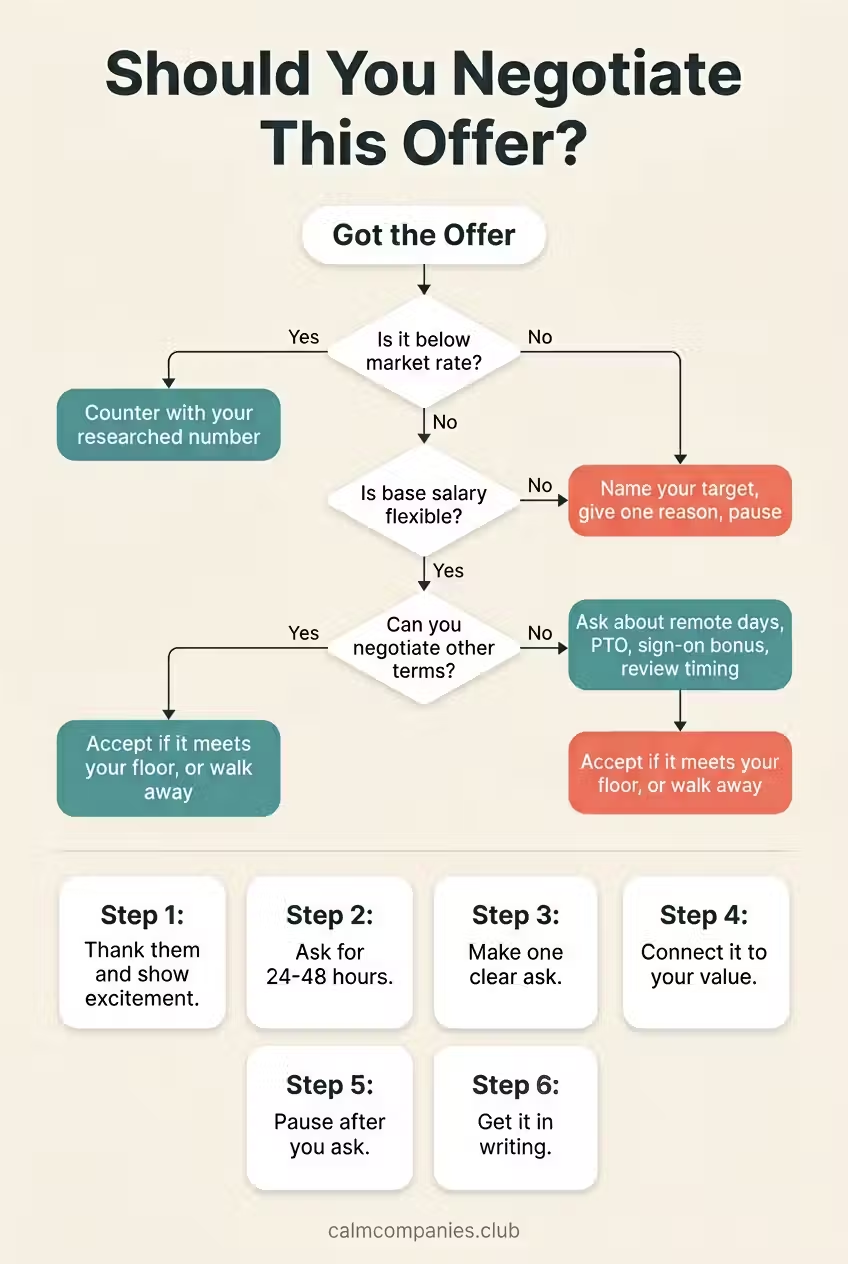
How to Negotiate a Job Offer in 6 Steps
Most successful negotiations follow the same structure. You are not improvising a debate. You are guiding a short business conversation toward a better outcome.
- Thank them and show genuine enthusiasm. Confirm that you are excited about the role so the conversation feels collaborative from the first sentence.
- Ask for a little time if you need it. A simple 24 to 48 hours gives you room to review the full package and choose your priorities.
- Make one clear, specific ask. Most candidates weaken their position by talking in circles or giving a vague range.
- Connect your ask to value. Mention the scope of the role, your experience, scarce skills, leadership responsibility, or measurable results.
- Pause after you ask. Silence is not failure. It is space for the employer to think.
- Confirm the final agreement in writing. Once you reach alignment, get the updated terms into the written offer before you celebrate.
That is the core process whether you negotiate by phone, Zoom, or email. The details change, but the structure rarely does.
What You Can Negotiate in a Job Offer
Salary gets most of the attention, but it is only one lever. If base pay is tight, other terms can materially improve your quality of life and your total compensation.
- Base salary
- Sign-on bonus or relocation support
- Equity, commission structure, or variable pay targets
- Title, level, or reporting scope
- Remote work days, hybrid expectations, or schedule flexibility
- Paid time off, start date, or pre-planned time off
- Equipment budget, learning budget, or certification support
- Early compensation review, ideally at three or six months
Think in terms of the whole offer, not just the headline number. A slightly lower salary can still be the better deal if the role offers sane hours, flexible work, and a review schedule you can count on.
Before You Negotiate, Do the Homework
Preparation does most of the work. When negotiation feels awkward, it is usually because a vague hope has not been turned into a clear ask.
- Define your ideal number, your target number, and your walk-away point.
- Review salary data from more than one source, then adjust for location, level, and company size.
- Write down the evidence that supports your ask: years of experience, niche skills, leadership scope, or measurable wins.
- Choose one or two non-salary terms that matter if base pay cannot move.
- Decide who probably approves compensation changes: recruiter, hiring manager, finance lead, or compensation team.
- Know what you will do if the final offer does not move enough. Clarity makes your tone steadier.
Use the offer stage to test the day-to-day reality of the job, not just the pay. These work-life balance interview questions can help you find out whether the company respects boundaries or simply says the right things.
If you are still unsure about team health or company direction, ask targeted questions before you sign. This guide to interview questions to ask employers is a solid checkpoint when stability matters as much as compensation.
Your best leverage comes from specificity. When you know what you want and why you want it, you sound like a professional making a business decision, not a nervous candidate hoping to get lucky.
How Much More Should You Ask For in a Job Offer?
Most people ask the wrong version of this question. The better question is: what number would make you accept quickly and feel good about the decision six months from now?
- If the offer is below your researched market range, counter toward the middle or upper end of that range.
- If the offer is already in range, ask for the number that would make the move clearly worthwhile for you.
- If you expect negotiation, ask slightly above your true target so there is room to land where you want.
- If the company says compensation is banded, shift your attention to bonus, review timing, flexibility, or paid time off.
Example: if you would happily take 120,000 and the first offer is 112,000, a counter at 124,000 or 125,000 is usually more strategic than asking for 120,000 immediately. You give them room to meet you in the middle without forcing them to guess what you actually want.
Do not inflate a number just because someone online said to ask for 20 percent more. Your ask should be high enough to create movement and reasonable enough to survive scrutiny.
A good counteroffer is not random, and it is not purely emotional. It sits at the intersection of market reality, your leverage, and the cost of leaving your current situation.
Salary Negotiation Script for a Phone Call
Live conversations are often the fastest way to negotiate because tone carries confidence. You can be warm, direct, and brief without sounding rehearsed.
Thank you again for the offer. I am excited about the role and the team. Based on the scope of the position and my experience in [relevant area], I was hoping we could move the base salary closer to [target number]. If there is flexibility there, I would be ready to move forward with enthusiasm.
Notice what this script does. It signals interest, states a number, gives a reason, and stops talking.
If the offer is below your target
I appreciate the offer, and I am genuinely interested. Based on my background and the market for this kind of role, I was targeting something in the [target range] range. Is there room to move the base salary to [specific number]?
If the salary is close, but you want the top of the range
I am excited about the offer. To make this move an easy yes for me, I would be looking for a base salary of [specific number]. Given the scope we discussed, especially [project, team size, revenue impact, or specialty], is that something you can support?
If the role is bigger than the title suggests
I am enthusiastic about the opportunity, especially because the role seems broader than the title alone suggests. Since the responsibilities include [scope], I would like to discuss whether the compensation can better reflect that level, ideally at [specific number] or with a title adjustment.
If you tend to talk fast when you are nervous, write your number on a note and keep it in front of you. The goal is not to sound slick. It is to sound clear.
You do not need to explain every line of your resume. Give one or two reasons that matter most, then let the employer respond to the actual ask.
How to Negotiate a Job Offer Over Email
Email works well when you want precision, when the recruiter initiated by email, or when you want a written trail. Keep it short enough to read on a phone and specific enough to answer in one reply.
Subject: Offer for [Role] Hi [Name], Thank you again for the offer. I am excited about the opportunity and can see myself making a strong impact in this role. After reviewing the package, I would like to ask whether there is flexibility to move the base salary to [specific number], based on my experience with [relevant skill or result] and the scope of the role. If that is possible, I would be happy to move quickly. Thank you for considering it. Best, [Your Name]
The best email negotiations are boring in the best way. They are polite, specific, and easy to answer.
Job offer negotiation email template: base salary is low
Hi [Name], Thank you for sending the offer. I am very interested in the role. Based on the responsibilities and my background in [area], I was expecting a base salary closer to [number]. Is there room to adjust the offer in that direction? I appreciate your time and would be glad to discuss by phone if helpful. Best, [Your Name]
Email template: salary is fixed, but you want other terms
Hi [Name], Thank you again for the offer. I understand if the base salary is set. In that case, I would love to discuss whether there is flexibility on any of the following: a sign-on bonus, an earlier compensation review, additional paid time off, or a more flexible remote schedule. I am excited about the role and would be happy to work through options that make the package a better fit. Best, [Your Name]
Avoid long backstories, emotional language, and apologies. A negotiation email is not a memoir. It is a decision memo.
If the recruiter replies with a meeting request, that is usually a good sign. It means they are willing to discuss your ask instead of rejecting it outright.
What to Say When Negotiating Salary: Exact Phrases
Here are the lines that make negotiations feel easier. Use them as written, or trim them to fit your voice.
- Thank you, I am excited about the offer.
- I would like a day to review the full package.
- Based on the scope of the role, I was hoping for [number].
- What flexibility do you have on base salary?
- To make this an easy yes for me, I would be looking for [number].
- If base salary is fixed, I would like to discuss other parts of the package.
- If we can get closer to [number], I would feel great moving forward.
- I understand if that is outside the band. What alternatives can we explore?
- Can we put that updated agreement in the written offer?
You are not trying to sound clever. You are trying to sound like someone who knows what they need and can discuss it professionally.
How to Negotiate Benefits in a Job Offer
Sometimes the best negotiation is not about money. It is about protecting your time, your energy, and the conditions that let you do excellent work without burning out.
Validate employers before final rounds
Check stability and workload indicators before you accept the offer.
Remote work and schedule flexibility
This matters more than many candidates admit. Two remote days, a protected no-meeting block, or a clear end to after-hours Slack can change the job more than a small salary bump.
I am excited about the role, and I want to set myself up to do my best work. Would there be flexibility for [remote days, core hours, or a hybrid arrangement]? That structure would make a meaningful difference for me.
Paid time off, start date, and work boundaries
These asks work especially well when salary bands are rigid. They also signal that you are thinking seriously about how to start well, not just how to squeeze the offer.
If the base salary is fixed, I would like to discuss whether there is room for [an additional week of paid time off, a later start date, or a pre-planned time off commitment]. That would make the offer much stronger for me.
Sign-on bonus, equity, and review timing
A sign-on bonus can bridge a gap when you are leaving unvested equity or an annual bonus behind. An earlier performance review can also create a path to higher pay without forcing the company to change a pay band immediately.
If the base number cannot move, could we explore a sign-on bonus, an equity adjustment, or a compensation review after six months based on agreed goals? One of those options could help us close the gap.
When you ask for alternatives, do not fire off a wish list of eight items. Pick the one or two that matter most and make it easy for the employer to say yes.
What to Say If They Push Back
Pushback is normal. A no is often the start of the real negotiation, not the end.
- If they say the package is their best offer: "Thank you for being direct. If base salary is fully fixed, is there flexibility on bonus, paid time off, review timing, or remote work?"
- If they say they have strict salary bands: "I understand. Where does this offer sit within the band, and what would put me at the higher end over time?"
- If they say they need a quick answer: "I can move quickly. I just want to evaluate the full package carefully, and I can get you a decision by [specific time]."
- If they say they do not want a bidding war: "I am not trying to create one. I am looking for a package that matches the scope of the role and makes this a strong long-term fit."
- If they say no: "Thanks for checking. Before I decide, can we explore any flexibility on [one alternative term]?"
Stay calm, and do not punish them for holding a line. You are trying to preserve the relationship while improving the offer.
This is also where patience matters. Some recruiters need time to go back to compensation, finance, or the hiring manager. Do not treat a delayed answer as a hidden rejection.
Mistakes That Weaken Your Leverage
Most negotiation mistakes are not aggressive. They are vague, apologetic, or poorly timed.
- Asking without stating a number
- Giving a huge range instead of a clear target
- Talking too much after you make the ask
- Making it personal instead of business-focused
- Bluffing about other offers
- Negotiating before you understand the role or the full package
- Ignoring flexibility, title, benefits, and review timing
- Accepting verbally before you have decided
- Turning one reasonable ask into a laundry list
Another common mistake is negotiating from fear. If you treat any pushback as a sign the offer will disappear, you will settle too early and resent it later.
The opposite mistake is negotiating from ego. If the offer already meets your needs and the role fits your life, do not create friction just to prove that you can.
When Not to Negotiate a Job Offer
You can almost always ask, but there are moments when a full negotiation is not the smartest move. Read the structure of the offer and your own leverage honestly.
- If the employer clearly states the package is standardized and non-negotiable, make one respectful ask or ask about alternatives, then stop.
- If the offer already exceeds your target and the role strongly matches what you want, do not negotiate just to prove you know how.
- If you still have unresolved concerns about burnout, stability, or scope, get answers first, then negotiate.
- If the company is moving unusually fast or feels evasive, your best move may be to slow down or walk away, not bargain harder.
Negotiation is a tool, not a ritual. Use it to improve a decision, not to decorate one.
Three Realistic Negotiation Examples
Example 1: The offer is below market
You receive an offer at 95,000, but your research suggests 105,000 to 115,000 is reasonable. You thank them, say you are excited, and counter at 112,000 with evidence tied to your experience and the scope. They return at 107,000, and you decide that works.
Example 2: The salary is near the top, but the job will be demanding
The base pay is close to your target, but the role includes frequent cross-functional work and a heavy meeting load. Instead of pushing only on salary, you ask for a six-month compensation review and clearer hybrid expectations. That protects your upside and your weekly reality.
Example 3: The calm company version of negotiation
The offer is solid, but you care most about sustainable work. You negotiate for a later start date, two firm remote days, and written agreement on a meeting-light block each week. That kind of negotiation can be worth more than a small increase in base pay, especially if it keeps the job livable.
This is why every negotiation should start with priorities, not tactics. The best counteroffer is the one that solves your actual problem.
Job Offer Negotiation Checklist
Use this before you reply to any offer. If you can answer every item clearly, you are ready.
- I know my ideal number, my target number, and my floor.
- I know which one or two non-salary terms matter most.
- I can explain why my ask is reasonable in one short sentence.
- I have decided whether to negotiate by phone or email.
- I have written my exact ask and practiced saying it out loud.
- I know how I will respond if they say the salary band is fixed.
- I have reviewed health benefits, bonus structure, equity, paid time off, and schedule expectations.
- I have asked my final questions about scope, team health, and stability.
- I know the date and time by which I will respond.
- I am prepared to accept, keep negotiating, or walk away.
Want a cleaner version of this list, plus scripts you can copy before a call or email? Get the free cheat sheet PDF by email, and use the Calm Companies job board to find employers that respect both your work and your life.
FAQ
Is it okay to negotiate a job offer?
Yes. In most professional roles, a respectful, specific counteroffer is expected. Employers anticipate that some candidates will ask, especially after they have decided you are the person they want.
How do you negotiate a job offer without sounding ungrateful?
Lead with enthusiasm, make one clear ask, connect it to value, and keep the tone collaborative. Gratitude and negotiation can happen in the same sentence.
What percentage should you counter on a job offer?
There is no magic percentage. Counter based on market range, scope, and the number that would make the move worthwhile, then leave room to land at your target.
Can negotiating a job offer cause them to rescind it?
It is possible but rare when your ask is professional and reasonable. Offers are more likely to get shaky when candidates bluff, make extreme demands, or handle the conversation combatively.
Should you negotiate a job offer over email or phone?
Phone is often faster and warmer. Email is better when you want precision, documentation, or extra time to think before you respond.
What if the salary in a job offer is non-negotiable?
Ask where the offer sits within the band, then explore sign-on bonus, equity, paid time off, flexibility, or an earlier review. If nothing can move, decide whether the total package still works for you.
How long should you wait before negotiating a job offer?
Usually within 24 to 48 hours of receiving the offer, unless the employer gives a specific deadline. That window shows seriousness without dragging the process out.
Should you negotiate benefits as well as salary?
Yes, if those terms affect your life or earning potential. Remote flexibility, paid time off, review timing, bonus, title, and start date can be easier for employers to adjust than base pay.
Get calm-company opportunities every week
Use the directory and subscribe so you can move fast when better roles open.