Is My Boss Toxic? 10 Red Flags + Free Quiz
A scored toxic-boss checklist: 10 red flags, gaslighting versus feedback, and a documentation playbook — plus a free quiz when you want a second look.
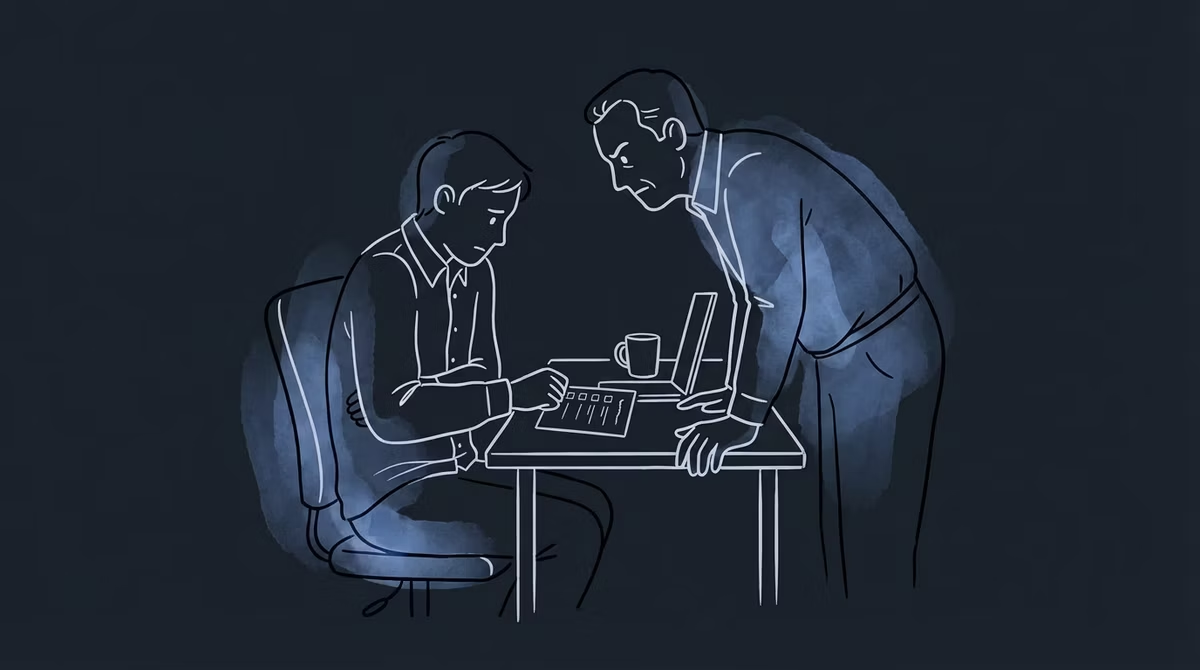
If you are searching "is my boss toxic," you probably do not need another vague article about bad managers. You need a way to tell normal job stress from a pattern that keeps draining your energy, confidence, and career momentum. This guide is a scored toxic boss checklist: 10 red flags you can mark, a plain-language test for gaslighting versus feedback, and the documentation steps that make the next conversation — with HR, a mentor, or yourself — less foggy.
A toxic boss is not just demanding. The problem is repeated behavior that creates fear, confusion, favoritism, chronic overwork, or pressure to ignore your own boundaries. One hard week is data. The same week, month after month, is a system. If the pattern extends beyond one manager, compare what you are seeing with our guide to signs of a toxic workplace. If you already know you need tactics while you stay, skip ahead to how to deal with a toxic boss without quitting.
When you want the interactive version of this scorecard, take the free is my boss toxic quiz. The article and the quiz use the same 0–20 scale so you are not comparing two different rulers.
A demanding boss is not the same as a toxic boss
High standards are not the problem. Plenty of good managers are direct, picky about quality, and uncomfortable in a crunch week. What they do not do is make the work itself harder to do. A demanding boss can still be clear, fair, and accountable. A toxic boss adds instability, humiliation, favoritism, or manipulation on top of the job. You can miss a deadline with a demanding boss and still know where you stand. With a toxic boss, the target moves after you have already run at it.
Hold that distinction while you score. This checklist is not a personality test and it is not a diagnosis. It is a way to stop arguing with yourself about tone and start counting behavior. If the flags cluster around one person, you are looking at a manager problem. If they show up in hiring, reviews, and how the company treats people who leave, you may be looking at bad company culture, not a single difficult human.
How to score the toxic boss checklist
Look at the last four to eight weeks, not the worst day of the year. For each red flag, give yourself 0 for never, 1 for sometimes, or 2 for often. "Sometimes" means it happens enough that you plan around it. "Often" means you would be surprised if a typical week did not include it. Add the ten scores. The maximum is 20.
- 0–6: friction, a weak habit, or a stretch of real business pressure. Still worth one clean conversation and a written recap.
- 7–13: a pattern. Document it, test one boundary, and decide whether the company has a real path to fix it.
- 14–20: treat this as a protection problem, not a motivation problem. Build an exit option even if you stay for now.
Score the behavior, not your loyalty. People who care about the work tend to under-count because they can explain every incident. If a friend described the same week, would you still call it a one-off?
10 toxic boss red flags (scored)
Each flag below is a row on the scorecard. Read the description, then assign 0, 1, or 2 before you move on. If you want workplace bullying examples in plain language, several of these are that list: public humiliation, credit theft, exclusion, and a private set of rules for people the manager likes.
1. Feedback turns into humiliation
Healthy managers correct work. A toxic manager uses feedback to embarrass people, prove power, or keep the team off balance. If criticism regularly happens in public, comes with sarcasm, or attacks your character instead of the work, that is a bad-boss red flag rather than a coaching-style difference.
- Score 2: comments are personal, performative, or staged in front of the team.
- Score 1: tone is sharp more often than it needs to be, but the content is still about the work.
- Score 0: corrections are specific, private when they should be, and you leave knowing what to change.
2. Expectations change without warning
One of the clearest signs of a toxic boss is moving the target after you have already done the work. Goals shift, priorities reverse, and success gets redefined in a way that makes you look careless. Isolated churn happens on every team. The pattern is what matters: you are blamed for not anticipating a change nobody wrote down.
- Score 2: scope or success criteria change after delivery, and you absorb the blame.
- Score 1: priorities move, but someone names the tradeoff when they move.
- Score 0: changes are explicit, dated, and owned by the person who made them.
3. Credit flows up and blame flows down
A difficult manager may be inconsistent. A toxic boss regularly takes ownership of wins while making sure someone else absorbs the downside. If your ideas become their ideas in the room that matters, but every setback becomes a personal failure on your side, you are dealing with a power problem, not a communication problem.
- Score 2: your work is renamed when it succeeds and attached to you when it fails.
- Score 1: credit is sloppy, but blame is not systematically dumped on the same people.
- Score 0: wins and misses are described in terms of the work, not a hierarchy of who is allowed to look good.
4. Boundaries are treated like disloyalty
Watch how your boss responds when you protect your time. Do they frame a normal log-off, a vacation, or a "not tonight" as a lack of commitment? A toxic boss often creates a culture where constant availability is the real measure of trust. That is also how a personal toxic-boss problem becomes a wider toxic workplace checklist item: the team learns that rest is a political risk.
- Score 2: saying no, taking PTO, or being offline is punished or mocked.
- Score 1: after-hours pings are common, but a clear decline is usually respected.
- Score 0: hours and response norms are named, and recovery is treated as part of the job.
5. Favoritism changes the rules
Every team has closer working relationships. A toxic manager uses favorites to control the room. Certain people get information early, avoid consequences, or receive exceptions that others could never ask for. When fairness disappears, performance becomes harder to measure and team trust collapses fast.
- Score 2: there is an inner circle with a different rulebook.
- Score 1: some people are closer to the manager, but standards still apply in public.
- Score 0: access and consequences are explainable without naming who is liked.
6. Urgency is constant, even when nothing is urgent
Some bosses manufacture pressure because urgency keeps people from asking better questions. If everything is labeled critical, deadlines arrive without planning, and emergencies seem to originate from your manager rather than the business, the chaos may be a control strategy. Reactive teams are easier to manage than teams with time to think.
- Score 2: false urgency is the default operating system.
- Score 1: crunch happens, then the week returns to something you can plan.
- Score 0: urgency is reserved for real constraints, and someone can explain why.
7. Information is withheld and then weaponized
A toxic boss may keep context vague, skip key decisions, or leave expectations implied. Later, that missing information gets used against you as proof that you should have known better. When people are punished for not reading minds, the system is designed to create dependence and self-doubt. That is adjacent to quiet firing: starve someone of context, then treat the resulting misses as evidence they are not a fit.
- Score 2: you are kept out of the loop, then graded on what you were not told.
- Score 1: communication is messy, but asking for context is allowed.
- Score 0: decisions, owners, and "done" are written down.
8. You are pressured to ignore ethics, policy, or reality
One of the most serious signs of a toxic boss is pressure to mislead customers, hide mistakes, skip process controls, or soften facts for leadership. You do not need a dramatic scandal for this to count. Small ethical compromises are often the earliest warning that your boss values self-protection over integrity. This flag also overrides a middling total score: even a 6 is not "fine" if someone is asking you to lie.
- Score 2: you have been pushed to hide, spin, or skip something that matters.
- Score 1: corners get talked about; you have not been told to take one.
- Score 0: raising a risk is treated as part of the work.
9. Micromanagement replaces trust
Not every detail-oriented leader is toxic. The line gets crossed when oversight becomes surveillance, second-guessing, and constant interruption. If your boss needs to approve every move, rewrites work to reassert authority, or makes you feel incapable of independent judgment, you may be dealing with a manager who needs control more than results. For the narrower pattern, read signs of micromanagement.
- Score 2: you cannot finish a task without check-ins that add no information.
- Score 1: they stay close on new work, then step back once they have seen you do it.
- Score 0: they set the outcome and leave the path to you unless they asked to be involved.
10. Your health, confidence, or identity is shrinking
The final test is impact. A toxic boss often changes how you sound, think, sleep, or show up outside work. If you feel dread before meetings, replay conversations at night, stop speaking up, or notice physical stress that eases when your boss is away, treat that as signal. Your body is not a dramatic narrator. It is an early warning system.
- Score 2: sleep, appetite, or self-talk are worse in a way other people have noticed, or you feel like a smaller version of yourself at work.
- Score 1: you are tired and watchful, but you still recognize yourself.
- Score 0: hard weeks happen; they do not follow you home as a new personality.
Validate employers before final rounds
Check stability and workload indicators before you accept the offer.
How to read your score
Add the ten numbers. Then look at which flags carried the weight. A 12 built from humiliation, withheld information, and shrinking health is a different situation than a 12 built from urgency and messy expectations during a real launch. The first needs protection. The second might need a priority reset and a written plan — or it might be the start of the first.
- If flags 1, 7, or 8 are a 2, do not wait for the total to "get bad enough." Those are dignity, reality, and ethics.
- If flag 10 is a 2, treat recovery as part of the plan, not a reward you get after you prove you can endure more.
- If most flags are a 1 and none are a 2, you may have a sloppy manager. Ask for clarity in writing before you decide they are toxic.
Want a second pass with scenarios instead of a list? The free toxic boss quiz walks the same ten patterns in five minutes. Use the article to think; use the quiz when you want a score you did not assign while arguing with yourself.
Gaslighting vs feedback
This is the distinction people ask for after they finish the checklist. Feedback is information you can use. Gaslighting is a campaign to make you distrust the information you already have. Both can be delivered in a calm voice. Tone is not the test.
Feedback names a specific piece of work, a standard, and a next step. It can be blunt. It can sting. It stays attached to something you can point at: a doc, a customer conversation, a date. You may disagree with it and still recognize the event it refers to. A week later, the story of what happened has not been rewritten.
Gaslighting attacks the record. You are told a conversation did not happen, that you "always" overreact, that nobody else saw what you saw, or that the goal was obvious when it was never stated. The aim is not better work. The aim is to make you an unreliable witness to your own week. Isolated forgetfulness is human. A pattern of denial after you start keeping notes is not a memory problem on your side.
- Feedback: "The client deck skipped the pricing slide we agreed on Tuesday. Please add it and send it by 3." You can comply or debate the slide. The Tuesday meeting still exists.
- Gaslighting: "We never agreed to that slide. You are rewriting history. This is why people do not trust your judgment." The meeting did happen. The target is your confidence, not the deck.
- Feedback can be public when the work is public. Gaslighting often recruits the room: jokes that you are "sensitive," side comments that you imagined the deadline, pressure to drop a recap email because it is "unhelpful."
- A useful check: write the fact in one sentence with a date. If a reasonable peer who was there would sign that sentence, you are not confused. If your boss needs you to unsay the sentence, you are being managed by fog.
You do not have to win a semantic argument about the word gaslighting. You have to keep a record that still makes sense when you reread it on a calmer day. That record is also what turns a vague "my boss is toxic" story into something an HR partner, attorney, or future you can use.
Workplace bullying examples that overlap with a toxic boss
Not every toxic boss is a bully, and not every bully is a manager. The overlap is large enough that people search both phrases for the same week. Workplace bullying examples that show up in this checklist include public shaming, spreading a private joke about you, excluding you from the meeting where the work is assigned, dumping an unfinishable load on one person, and applying rules only to people outside the inner circle.
If the behavior is aimed at you and the rest of the team is fine, you may be looking at targeting — including the slow version described in quiet firing signs. If the whole team is living the same flags, you are closer to a toxic workplace than a single bad relationship. Either way, the next move is the same: write it down before you decide whether to stay, escalate, or leave.
Documentation steps that keep the story stable
Start by documenting patterns, not emotions. "I felt dismissed" is true and easy to wave away. "On March 12 and March 19 the deadline changed after I had already shipped, and I was marked late on both" is harder to rewrite. Specific examples also help you notice whether the pattern is escalating. Keep the log on a personal device or a personal account. A work laptop is not a locker.
- Open a private dated log. For each incident, write what happened, who was there, what was said (quotes if you can), what changed afterward, and the business impact. One paragraph is enough.
- Separate facts from feelings with a blank line. Keep both. Feelings tell you the cost. Facts tell you the case.
- After verbal instructions, send a short recap: priority, owner, deadline, tradeoff. "Reply if I missed anything" is enough. You are not being passive-aggressive. You are closing the edit window.
- Save the original messages. Exports beat screenshots when you can get them. Do not store this in a shared drive your boss can tidy.
- Keep a short list of wins with dates and links: shipped work, praise, metrics. A toxic review often starts by shrinking the past. Your baseline should not live only in their head.
- Note frequency. A weekly tally of flags 1–10 is more useful than a novel. If you later take the quiz, you will already have the weeks in front of you.
- Decide, in writing, what would change your mind. "If priorities stay written for 30 days" is a test. "If they apologize" is not.
Documentation is for you first. It keeps you from gaslighting yourself on a better week. It is also what you bring to a mentor, HR, or an employment attorney if the facts include discrimination, retaliation, harassment, pay problems, or pressure to hide the truth. You do not need a legal theory to start the log. You need dates.
What to do if you think your boss is toxic
You do not have to quit this week, and you do not have to pretend nothing is happening. The useful middle is a protection plan. The longer version of these moves lives in how to deal with a toxic boss without quitting. The short version is below.
- Test one clean boundary. Ask for priorities in writing, confirm the deadline, or summarize the decision after the meeting. Toxic bosses usually dislike clarity because it limits revisionist storytelling. Even if the behavior does not improve, your file gets stronger.
- Widen the support system by one or two people: a trusted peer, a mentor, a therapist, or an HR partner if there is a realistic channel. Do not isolate. Toxic managers gain power when people feel ashamed or uniquely defective.
- Protect the work you can still control. Keep core responsibilities visible and documented. Stop donating unlimited evening labor to chaos you did not create.
- Build an exit option before you desperately need one. Update the resume, save work samples, and sketch a runway. Staying longer is sometimes necessary. Staying passive is expensive.
Escalate sooner when the pattern includes retaliation, discrimination, threats, harassment, pay issues, or pressure to hide facts. Those are organizational risks, not style differences. Leave sooner when your health is deteriorating, reasonable boundaries trigger punishment, or the flags clearly belong to the company, not one desk. If two weeks of notice is not safe, use the resignation letter for a toxic boss and treat the letter as a clean exit, not a closing argument.
How to screen for a toxic boss in your next interview
The best time to deal with a toxic boss is before you report to one. Ask how priorities change, how feedback is delivered, what happens when a deadline slips, and how disagreements get resolved. Listen for specifics, not polished values language. Calm companies can explain how work actually happens when things go wrong. Toxic environments usually answer with slogans, urgency theater, or vague claims that people here just care a lot.
- "When a deadline slipped last quarter, what changed the following week — the date, the scope, or people's evenings?"
- "Can you describe the last time someone disagreed with you in a meeting, and what happened next?"
- "How do people on this team take time off, and are they reachable when they do?"
- "Where do decisions live after a meeting — a doc, a chat thread, or someone's memory?"
Ask the hiring manager and a future peer, not only the recruiter. Recruiters describe the intended company. Peers describe last Tuesday. Pair those answers with company culture interview questions and a look at how a company writes about work in public. Profiles such as Buffer and 37signals are useful because they name hours, remote defaults, or writing-first habits instead of stopping at adjectives. That is not a promise that every manager there is calm. It is a higher-resolution starting brief than a careers page that only says people are passionate.
If you want more of those briefs in one place, browse the Calm Companies directory and score the team you would join, not the brand.
Take the free quiz, then decide the next step
If this checklist raised more concern than you expected, treat that as information. Take the is my boss toxic quiz while the week is still fresh. The quiz is the same ten patterns in scenario form. It is not a verdict and it does not replace a doctor, a lawyer, or a friend who has seen you this year.
After you have a score, the useful question is not "was I right?" It is "what am I going to protect this month?" Some people need a documentation habit and one boundary. Some people need an exit letter. Some people need a quieter search. If you want a weekly list of openings from teams that design work around humans, you can subscribe to the digest or keep browsing companies until a profile sounds like a Tuesday you could live with. That is an invitation, not a homework assignment.
Frequently asked questions
Can a boss be toxic without yelling?
Yes. Many toxic bosses are quiet, polished, and politically skilled. The common thread is not volume. It is repeated behavior that creates fear, confusion, helplessness, or unfair dependence. Score the pattern, not the decibels.
What is the difference between a toxic boss and a demanding boss?
A demanding boss can still be clear, fair, and accountable. A toxic boss makes performance harder by adding instability, humiliation, favoritism, or manipulation. High standards are not the problem. The system around those standards is.
How do I tell gaslighting from harsh feedback?
Feedback points at work you can change and leaves the facts of the week intact. Gaslighting asks you to distrust your memory of what was said, promised, or decided. Write one dated sentence. If the story has to be unsayable for your boss to stay comfortable, you are not looking at coaching.
Should I quit immediately if my boss is toxic?
Not always. Leave immediately when health, safety, or ethics are on the line. In many other cases you need time to document, recover a little confidence, and line up the next role. The important move is to stop treating the situation like it will fix itself. If you do resign, the toxic-boss resignation letter guide covers a clean exit.
Is this the same as a toxic workplace checklist?
Related, not identical. This page scores a manager. A toxic workplace checklist scores the system: urgency as culture, blame in place of process, silence around turnover. Start here if the pain has a name. Use signs of a toxic workplace if the flags survive a manager change.
Where can I take an is-my-boss-toxic quiz?
Here: the free is my boss toxic quiz uses the same 0–20 scale as the checklist on this page. Take it after you have a couple of weeks of notes if you can. The log makes the answers less hypothetical.
Get calm-company opportunities every week
Use the directory and subscribe so you can move fast when better roles open.