Signs of Micromanagement (and How Calm Teams Differ)
Signs of micromanagement in plain language: how managing differs, what remote checking looks like, and questions to ask before you accept the offer.
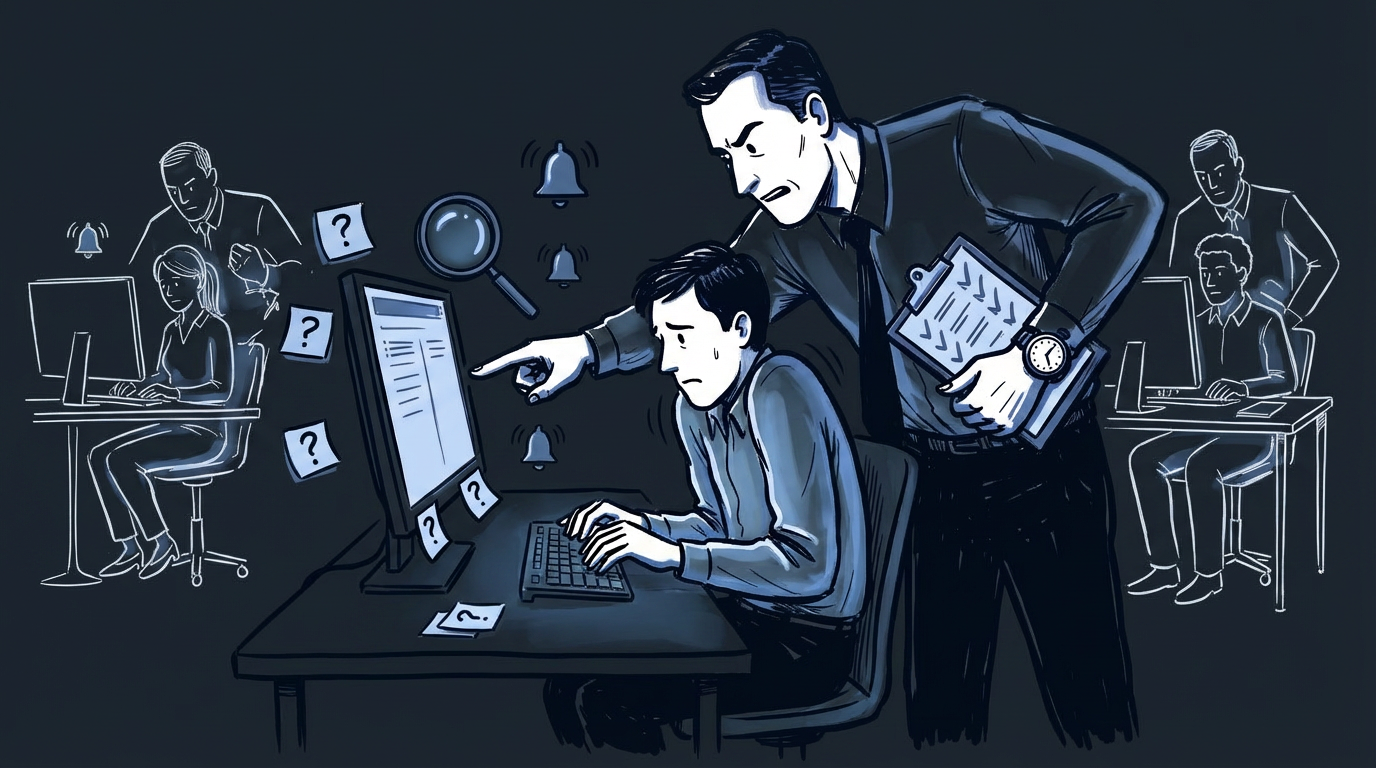
Signs of micromanagement are a pattern of control over work that already belongs to you. A manager approves routine decisions, rewrites methods that were working, and keeps the same grip after you have shown you can do the job. One extra check-in during a launch is ordinary management. The same checking, week after week, when nothing is new and nothing is blocked, is the pattern this page is about.
Micromanagement is narrower than a toxic boss. A toxic pattern can include public humiliation, credit theft, shifting rules, and punishment for honest feedback. Those are scored in is my boss toxic? 10 red flags and in the free is my boss toxic quiz. Control can sit inside that pattern, or it can be a manager who is anxious, new, or under pressure and has not learned to delegate. If the problem is the opposite of control — work removed, information withheld, a slow push toward the door — read quiet firing. Neglect and intrusion are different, and they ask for different responses.
What micromanagement is
Micromanagement is excessive control of work the role was hired to handle. The manager stays inside decisions, messages, and methods. The checking does not loosen once competence is obvious. Managing sets the outcome, the deadline, and the standard, then uses check-ins to remove blockers. Oversight that makes the work clearer is management. Oversight that makes the work smaller is micromanagement.
A reasonable explanation does not shrink the week. Anxiety, a first-time manager, pressure from above, or a habit of tying self-worth to being in every thread can all produce the pattern. You can understand the source and still count the cost. Score the last four to eight weeks, not the worst afternoon of the year. "Sometimes" means you plan around it. "Often" means a typical week includes it.
Managing names the outcome and gets out of the method. Micromanagement names the outcome and then stays in the method.
Micromanaging versus managing
Use the comparison as a reading of the work, not as a personality label. A single row can be a hard week. Several rows, in the same direction, over more than one month, are the sign.
| What you notice | Managing | Micromanaging |
|---|---|---|
| Decisions | The outcome, the deadline, and the standard are named. The method sits with the person doing the work. | Routine choices inside the role still wait for approval. |
| Check-ins | Updates happen at a milestone, or on a rhythm you both agreed, and they exist to clear blockers. | Updates arrive whenever anxiety spikes, including when nothing has changed. |
| Feedback | Notes are about the work. You leave knowing what to change. | Notes rewrite the method, the wording, or the formatting, and the goal gets smaller. |
| Presence | Live time is reserved for the conversations that actually need it. | Online status, reply speed, and cameras stand in for the result. |
| Trust over time | Oversight loosens once the person has shown they can do the job. | The same grip stays after a record of finished work. |
| What gets measured | The result, the quality, and the communication the work needed. | Activity: messages sent, minutes online, steps followed. |
Close oversight can still be management when you are new, when the work can hurt a customer, or when a skill is still being learned. The test is whether the support fades as the competence shows. If it does not fade, you are looking at control, not a training period.
Signs of micromanagement
Read these against a normal month, not against a story you tell yourself about one Slack thread. Any one of them can be innocent. The pattern is several of them, repeating, while your peers are not living the same week.
- You are asked for status when nothing meaningful has changed, and the ask itself interrupts the work.
- Small decisions need approval even when they sit inside the role you were hired for.
- The manager is more interested in how you worked than in whether the result did the job.
- They join meetings, threads, or tasks you already own, without a reason you could explain to a teammate.
- They rewrite, redo, or heavily edit the work and do not say what was wrong with it.
- You feel watched: status dots, breaks, time away from the desk, how fast you reply.
- Priorities move with the manager's anxiety rather than with a change in the work.
- You spend more energy avoiding scrutiny than doing the thoughtful version of the job.
Detail still matters on some work. A manager who catches a broken number in a customer-facing doc is doing the job. A manager whose feedback is mostly formatting, while the point of the work goes unmentioned, is staying in control of the surface. If the same behaviors show up in hiring, reviews, and how people who leave are described, you may be looking at bad company culture or the wider signs of a toxic workplace, not one anxious manager.
Remote-work red flags
Remote work changes where the checking shows up. It removes the desk, so a manager who needs to see work happening invents substitutes for the desk. The substitutes are the red flags. A written update, a camera for a real conversation, and a shared doc are ordinary tools. They become control when they exist to prove you were present.
- Green-dot policing. Your status, your cursor, or your "active now" state is treated as the job. A deep-work block that takes you offline gets a ping.
- Activity tools. Screenshots, keystroke logs, or always-on trackers measure motion. They do not measure whether the work was any good.
- Cameras as a default. A camera for a decision, a hard conversation, or a social hour can be reasonable. A camera required for ordinary working hours is surveillance.
- Immediate replies across time zones. The team is distributed on paper and synchronous in practice. Silence during someone's morning is read as absence.
- Copy-the-manager by default. Routine threads include the manager so they can watch the work, not because they have a part in it.
- Status meetings whose only product is proof you attended. The decisions were already in the doc, or they could have been.
- Async writing pulled back into a call so the manager can watch you think. The doc was the work. The call is the checking.
Pair this list with remote work policy red flags when the problem is the policy rather than one manager: mandatory overlap that eats the day, a remote title that still means a full shared workday, or a handbook that praises flexibility and a calendar that contradicts it. A calm remote week has a place for deep work and a known way to reach someone when the work is actually blocked. It does not require you to perform presence between those moments.
How to tell it is affecting you
The confusing part is that the pattern changes your behavior slowly. You can call it being careful. Often it is adapting to a room where ordinary work feels risky. Notice these shifts over the same month you used for the signs above.
- You rehearse simple messages because you expect them to be picked apart.
- You spend more of the day updating people than producing the work the update describes.
- You feel guilty logging off, stepping away, or working quietly, even when the work is on track.
- You hold back a better approach because the safe approach costs less attention.
- The goal of the day drifts from doing the work well to avoiding correction.
- Your confidence drops in decisions that have nothing to do with this job.
That stress does not stay in the work tool. If your concentration is gone, your patience is thin, or you are tired before the day starts, read overworked symptoms beside this page. Micromanagement and overwork reinforce each other: the checking adds hours, and the hours make the checking feel justified. This page is not a diagnosis. If your health is involved, talk to a clinician. A blog post is not care.
Interview questions that detect a micromanager
Ask before you accept. You are not trying to catch someone out. You are trying to learn how trust, ownership, and check-ins actually work on the team you would join. Vague praise ("we're like a family", "we trust people") is not an answer. A recent week is an answer. Use these questions next to company culture interview questions and work-life balance interview questions.
- What decisions can someone in this role make without asking? Listen for a real boundary: budget, scope, customer replies, technical approach. "It depends" with no example is not a boundary.
- How do check-ins work in a normal week, and what are they for? A milestone, a written update, or a standing half hour with a purpose is management. A day full of status, plus pings between the meetings, is checking.
- When someone is new, how does support change once they can do the job? You want to hear that oversight loosens, and you want an example. "I stay close to the work" with no later step is the grip.
- How do you know work is going well if you cannot see the person online? Output, a doc, a shipped change, or a customer result are answers. Reply time and a green dot are not.
- Tell me about a time someone on the team used a different method than the one you would have chosen, and it worked. A manager who can tell that story has let go of a method. A manager who changes the subject has not.
- What happens to chat and status when someone is in deep work, or off? You want a norm you could put on a calendar. "We're pretty flexible" is a slogan until they describe yesterday.
- Who cuts scope when a deadline and a full calendar land in the same week? Ask for a recent example. A name and a story mean someone protects the week. A speech about hustle means you will be managed by the leftover hours.
Validate employers before final rounds
Check stability and workload indicators before you accept the offer.
Talk to a peer if you can, not only to the hiring manager. Ask what last month looked like in hours, in meetings, and in who had to approve a small decision. Adjectives are not an operating system. If every answer centers on approvals, constant availability, or visibility into everything, believe the answers. You are evaluating how much room the job leaves to do the work.
How calm teams differ
A calm team still has a manager. The default week does not require you to be watched in order to be trusted. In the Calm Companies directory, autonomy is one of five things a profile can document, alongside hours, meetings, remote or async norms, and time off. Documented means the profile names a practice. It does not mean every team inside the company lives up to the sentence. Read the profile, then test it with the questions above.
Doist (Todoist and Twist) is the clearest written version. The profile says asynchronous communication is the default, that people get room for deep work without an expectation of immediate replies, and that performance is judged by output and communication rather than presence. It also says the company discourages invasive time-tracking and micromanagement. That sentence is the one to test, not a trophy. The Doist careers deep dive walks through what else is on the card, including the parts that are still an interview question.
37signals describes the contributor they want as a "manager of one": write-first updates, and real-time conversation as the exception. The directory profile names a standard 40-hour week, reduced to 32 hours in summer. The 37signals careers deep dive is the same scorecard applied to that profile. Ghost documents a light calendar — most people have one or two video calls a week — and treats ownership as the job, with an explicit warning that a rigid ladder is a poor fit. Plausible Analytics documents broad ownership on a very small remote team. A small team can still be run by checking. Ask who cuts scope when a customer issue and a product change land together.
None of those profiles is a promise that your future manager will be calm. They are examples of practices that make constant checking harder to hide, because the company has already said, in public, what a week is supposed to look like. The method for reading any profile this way is in best work-life balance companies to work for (2026). Start with the calm company fit quiz if you want the shortlist to match how you actually need a week to work, then open the directory and read three profiles before you fall in love with a job title.
If this is already your manager
You may not be able to change the pattern. You can see it clearly, protect some of the day, and decide whether a reasonable ask changes anything. The goal is not to win an argument about the word micromanagement. The goal is a week you can do the job in, or a clear answer that you cannot.
- Write down specific weeks. Dates, the approval that was required, the work that was redone, the ping that interrupted a block of focus. A feeling is easy to argue with. A list is not.
- Ask for outcomes, not for a new personality. Name the result, the deadline, and which decisions are yours. Ask which parts of the direction are requirements and which are preferences.
- Propose one check-in rhythm. A scheduled update instead of ad hoc pings gives a manager who wants visibility a place to get it, and gives you a place to point when the extra pings arrive.
- Send a short note before a deep-work block. What you are doing, when you will be back, what would actually need an interruption. Then notice whether the block survives.
- Watch the response to a reasonable boundary. A manager can adjust the rhythm and keep the standard. A micromanager often tightens the checking. That response is information.
If you can stay safely while you test this, the tactics for a hard manager live in how to deal with a toxic boss without quitting. If the control is chronic, your confidence is dropping, and the reasonable ask made the checking worse, the decision moves to should I quit my job. Do not resign into a neglect pattern that might still be a layoff. If work is being removed rather than over-controlled, read quiet firing before you do the company a favor.
Frequently asked questions
What are the signs of micromanagement?
Signs of micromanagement are a repeating pattern: status requests when nothing has changed, approval for routine decisions, a focus on method over result, a manager inserted into work you own, rewrites without an explanation, monitoring of presence, priorities that move with anxiety, and a day spent avoiding scrutiny. One hard week is not the pattern. Several of these, over more than a month, are.
What is the difference between micromanaging and managing?
Managing names the outcome, the deadline, and the standard, then uses check-ins to remove blockers. Oversight loosens once you can do the job. Micromanaging stays inside the method, requires approval for routine choices, and keeps the same grip after the work has been done well. The comparison is in the table on this page.
What are micromanagement red flags when the team is remote?
Green-dot policing, screenshot or keystroke tracking, cameras required for ordinary hours, immediate replies across time zones, a manager copied on routine threads, status meetings that only prove attendance, and async writing pulled back into a call so someone can watch you think. A written update and a camera for a real conversation are ordinary. They are red flags when they exist to prove presence. See also remote work policy red flags.
How can you tell a micromanager before you accept an offer?
Ask what you can decide without approval, how check-ins work in a normal week, how support changes after you can do the job, how they judge work they cannot see, and for a time someone used a different method and it worked. Ask a peer what last month looked like. Useful answers include a boundary, a rhythm, and a story. Controlling answers stay on approvals, reply speed, and visibility.
Is micromanagement the same as a toxic boss?
No. Micromanagement is excessive control of work that belongs to you. A toxic boss can include humiliation, credit theft, moving targets, and retaliation, with or without that control. Score the wider pattern with the is my boss toxic quiz. If the pattern is neglect rather than control, read quiet firing.
Should I quit because of micromanagement?
Quit is a decision about the pattern, a reasonable ask, and whether you can cover a search. Write the examples, ask for outcomes and one check-in rhythm, and see whether the checking loosens. If it tightens, and the cost is already your confidence or your health, use the should I quit my job framework. Do not resign to escape checking if the real pattern is quiet firing and a layoff might still pay you to leave, unless staying is unsafe.
If you want the next job to be one where autonomy is written down, start with companies that document it. Read Doist, 37signals, Ghost, and Plausible Analytics in the Calm Companies directory, and use the 2026 work-life balance guide as the scorecard. Then join the weekly digest for openings from calmer teams, instead of another midnight scroll through jobs that never describe the week.
Get calm-company opportunities every week
Use the directory and subscribe so you can move fast when better roles open.